Relay Based Automatic Voltage Stabilizer
TEAM MEMBERS
ABSTRACT
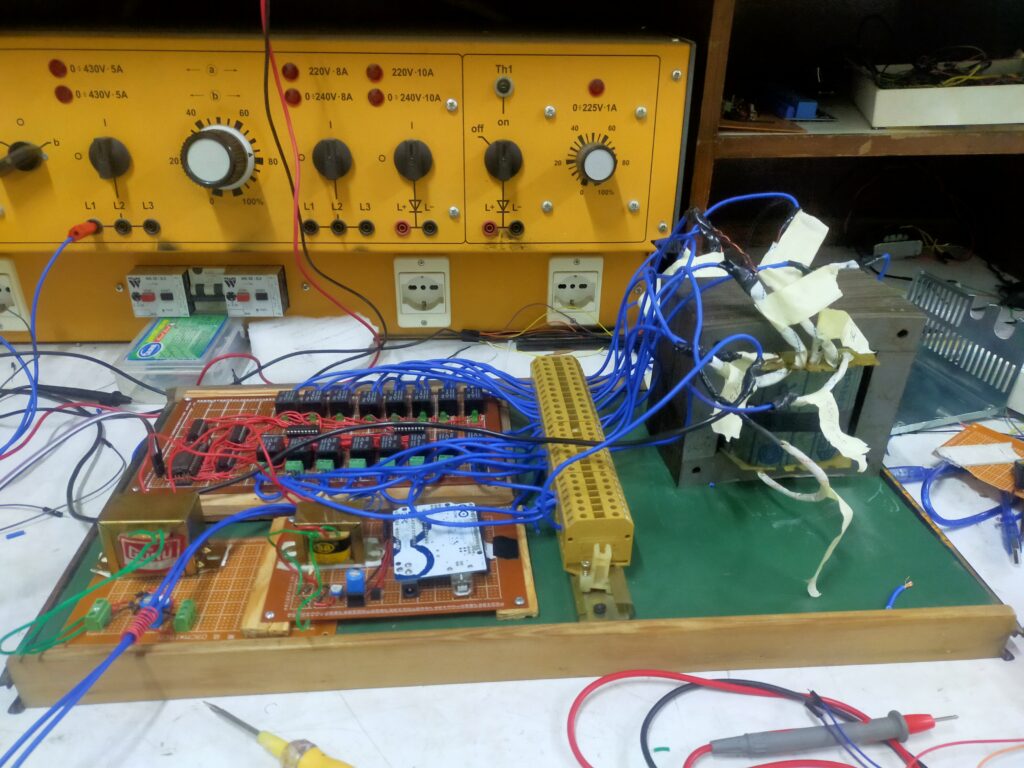
With the increasing power demand, it has become one of the biggest challenges to provide a stable and uninterrupted voltage supply to the consumers under various load conditions. The fluctuation in voltage values results in low performance and eventually damages the electrical appliances used. To fix this problem, an Automatic Voltage Stabilizer (AVS) is needed for households and industries. A voltage stabilizer is an electrical appliance that is designed to deliver a constant voltage to a load at its output terminals regardless of the changes in the input or incoming supply voltage. It protects the equipment or machine against over-voltage, under-voltage, and other voltage surges. A voltage stabilizer is also called an Automatic Voltage Stabilizer. It is responsible for correcting the AC voltage of the electrical power supply to provide a stable and secure power supply to equipment, allowing for a stable voltage and protecting the equipment from most of the problems of the mains. The project aims to make a relay-based Automatic Voltage Stabilizer. The control circuit consists of an autotransformer, relays, voltage comparators, microcontroller, demultiplexers, current, and voltage sensing units, flash ADC, and signal conditioning circuit. The system also consists of a display that displays the input voltage and output voltage in an instant. The control circuit operates within the fluctuation range of 190V to 260V. The power rating of this Automatic Voltage Stabilizer is 1kVA. This single-phase Automatic Voltage Stabilizer gives the output voltage of 220V with a sensitivity of ±1%. If the input voltage is lower than 180V and higher than 260V, the system automatically shuts down preventing the damage that could be caused to the system and the load. The system thus designed and fabricated could stabilize household electrical usage and prevent domestic appliances from being damaged. The primary focus of the system is to stabilize the voltage for domestic purposes.
Request Report: Here