// Projects / Automatic Water Pump Controller
PROJECTDesign of an Automatic Water Pump Controller
Overview
Residential water storage in Nepal and much of South Asia relies on rooftop or underground tanks filled by submersible pumps drawing from a municipal or borehole supply. Two failure modes impose recurring costs on occupants: overflow from an unattended full tank, which wastes water and can damage structural elements, and dry running when the tank empties and the pump continues operating against a closed suction, burning out the motor winding. This project eliminates both failure modes through a purely electromechanical controller that monitors tank level at two fixed setpoints and switches the pump motor accordingly, with no manual intervention required.
The design constraint that distinguished this project from a simple float-switch circuit is the requirement for bistable behavior: the pump must remain on continuously as the tank fills between the low and high setpoints, without being re-triggered by the continuously submerged low-level electrode. A relay latch circuit satisfies this constraint by holding itself energized through its own contact after the low-level electrode initiates pump start-up.
Technical Approach
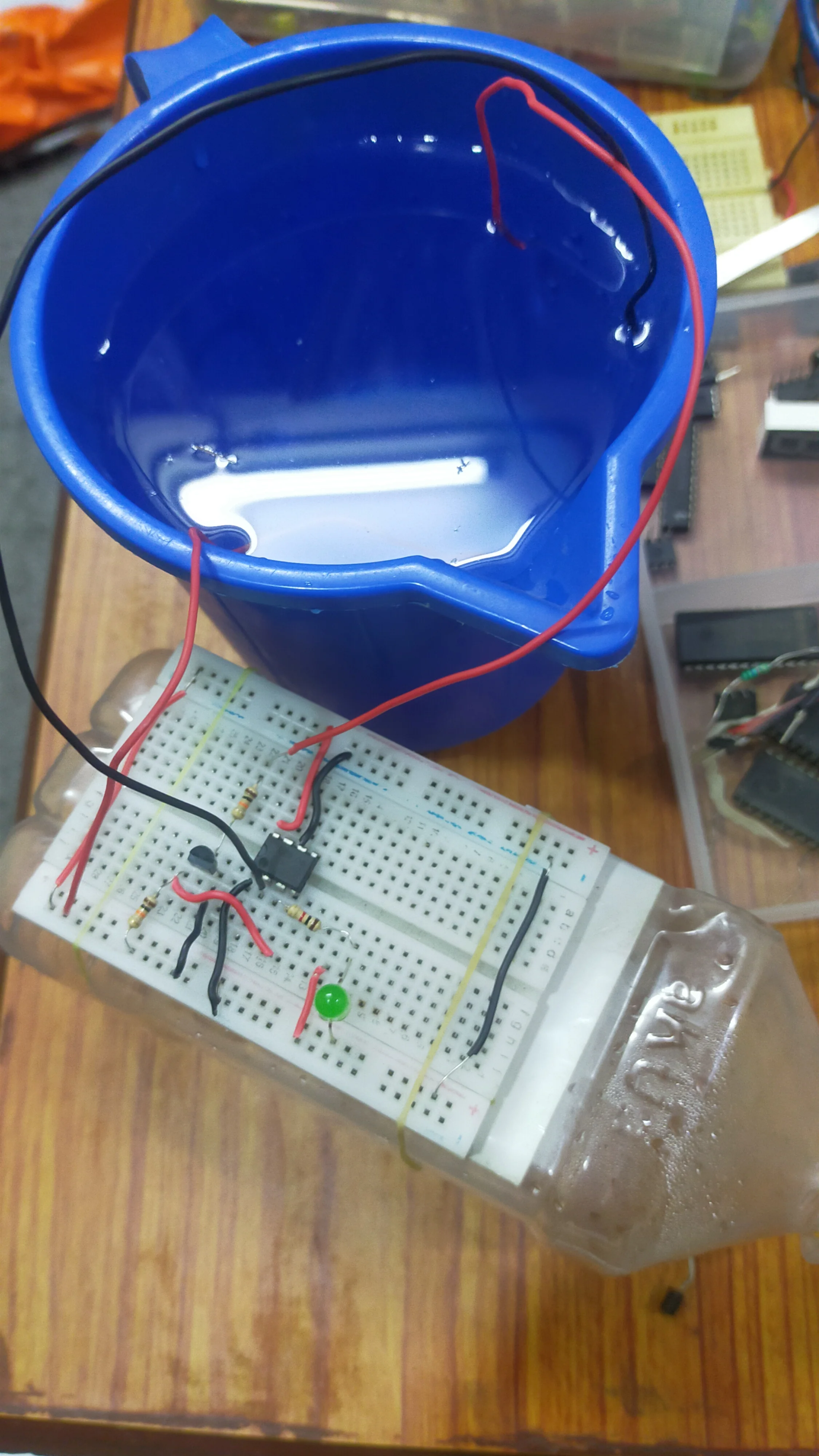
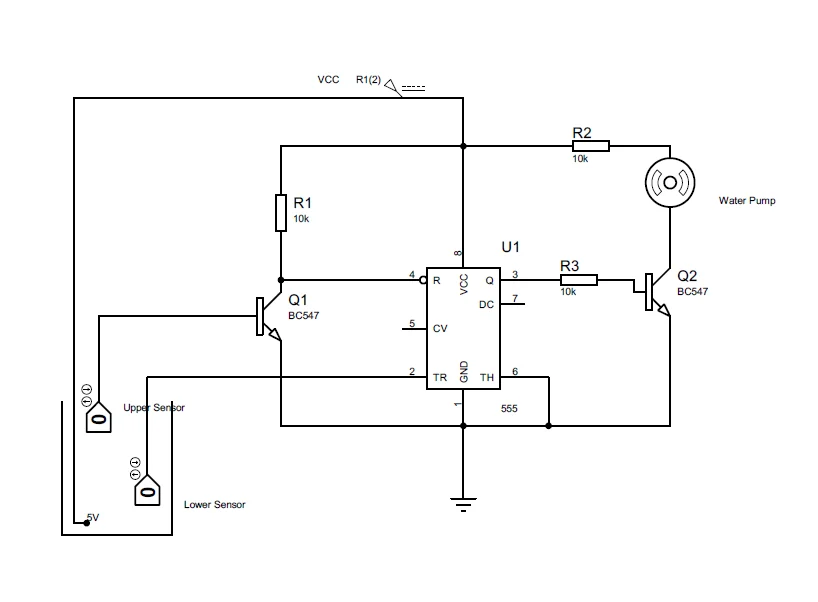
Water level sensing uses stainless-steel rod electrodes positioned at the tank low-level and high-level marks, plus a common ground electrode submerged at the tank floor. When water bridges the low electrode to the common ground, a small sensing current (limited to under 1 mA by a 10 kΩ series resistor to prevent electrolysis) flows through a BC547 transistor base circuit, saturating the transistor and energizing the set coil of an SR relay latch built from two DPDT relays cross-wired for latching. The latch's self-hold contact shorts the low-level transistor path, so the relay remains energized even after water rises above and eventually submerges the low electrode — removing the ambiguity that a simple level-sensing comparator would face during partial fill.
When water reaches the high electrode, a second sensing transistor energizes the reset path of the latch, breaking the self-hold and de-energizing the output relay coil. A 3-pole contactor, controlled by the output relay, switches all three phases of the submersible pump motor supply. Single-phase overcurrent protection at the contactor input guards against motor locked-rotor conditions. LED indicators on the control panel display three states: pump running (green), tank full (amber), and power present (white). A manual override toggle allows forced pump activation for flushing or maintenance, bypassing the level sensing entirely.
The sensing circuit operates at 12 V DC supplied by a small transformer and bridge rectifier, galvanically isolated from the 230 V AC motor circuit. This isolation ensures that a probe-wire fault cannot energize the tank water to mains potential, a critical safety requirement given direct human contact with the water supply.
Project Gallery
Outcomes & Learnings
The controller was tested through 30 consecutive fill cycles using a bench tank with adjustable electrode positions, verifying correct latch set and reset at both level thresholds with no false triggering. Simulated probe faults — including open-circuit and short-circuit electrode conditions — produced fail-safe behavior: an open low-level probe prevents pump start-up, and an open high-level probe leaves the pump running until the manual override intervenes, consistent with the principle that the safer failure mode for a water supply system is continued operation rather than lockout.
Electrode-based sensing proved more robust than the mechanical float switches it replaced: no moving parts subject to calcium fouling, no buoyancy variation with water density, and a deterministic switching point set by electrode physical position rather than float geometry. This reliability advantage is directly analogous to the preference for static relay technology over electromechanical relays in modern power system protection, reinforcing a design philosophy that recurs throughout the power engineering curriculum.
The project also introduced the bistable relay latch as a practical memory element — a concept that generalizes to contactor hold-in circuits, motor starter latching in SCADA systems, and interlock logic in substation automation, all of which became relevant in subsequent graduate coursework and research.