Projects › Regenerative Braking & EV Appliances
Final Year ProjectManagement of Regenerative Braking and Onboard Appliances in Electric Vehicle
Project Overview
Electric vehicles (EVs) waste a significant portion of kinetic energy as heat during conventional braking. This final-year project addresses that inefficiency by implementing a regenerative braking system that recovers kinetic energy during deceleration and channels it back into the battery. The recovered energy is further used to power onboard DC appliances, reducing parasitic drain on the main traction battery.
The project combined hardware prototyping with software simulation, designing the complete power flow from motor-to-battery recovery using a BLDC motor and H-bridge rectifier, and verifying the design through MATLAB/Simulink and Proteus before building the physical prototype.
Technical Approach
- A BLDC (Brushless DC) motor serves as both the traction motor and the generator during braking. When the vehicle decelerates, the motor transitions into generator mode and produces three-phase AC power.
- An H-bridge rectifier circuit converts the AC output of the BLDC motor during regenerative braking into DC, suitable for battery charging and appliance power.
- The recovered DC energy is managed through a power distribution circuit that simultaneously feeds the battery bank and supplies onboard DC appliances (lighting, fans, auxiliary loads).
- MATLAB/Simulink was used to simulate the entire energy recovery loop, validate power conversion efficiency, and optimize the switching logic for the H-bridge.
- Proteus was used for schematic design and PCB-level circuit simulation before hardware assembly.
Circuit Diagrams & Simulation
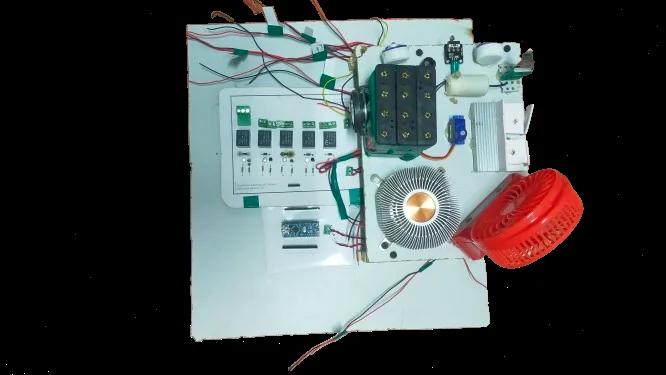
Onboard appliances power circuit
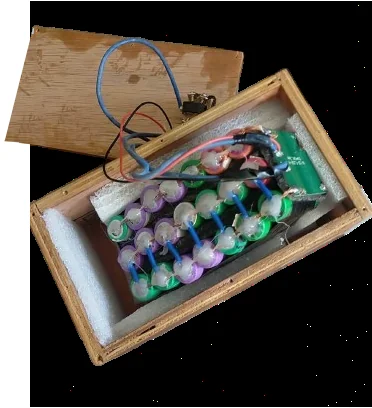
Battery bank configuration
Hardware prototype