Projects › LPG Leakage Detection and Exhaust
ProjectLPG Leakage Detection and Automatic Exhaust System
Project Team
Overview
Liquefied petroleum gas is the primary cooking fuel in urban Nepal, and cylinder valve leaks or regulator failures in poorly ventilated kitchens create explosion and asphyxiation hazards that are responsible for dozens of domestic accidents annually. This project designs a low-cost electronic safety system that detects LPG concentration above a defined threshold, immediately activates an audible alarm to alert occupants, and simultaneously switches on an exhaust fan to ventilate the space and drive the accumulated gas below the lower explosive limit (LEL) of approximately 1.8% by volume for propane/butane mixtures.
The design prioritizes sub-second response time and near-zero false alarm rate, since a system that triggers on cooking steam or perfume will be disabled by users — the most dangerous failure mode of any safety device. These dual constraints drove the sensor selection and signal conditioning architecture.
Technical Approach
The primary sensing element is an MQ-6 electrochemical gas sensor, which is specifically characterized for LPG (propane/butane) sensitivity and exhibits low cross-sensitivity to common kitchen vapors including water vapor, ethanol, and acetone at typical domestic concentrations. The MQ-6 operates on a heated metal-oxide semiconductor (HMOS) principle: its tin-dioxide sensing layer conductance increases in the presence of reducing gases, producing a decrease in the sensor's output voltage when connected in a load-resistor voltage divider. The heater coil draws approximately 160 mA at 5 V, and a 90-second warm-up delay circuit (implemented with an RC timer feeding a transistor gate) prevents false alarms during the sensor's initial stabilization period immediately after power-on.
The sensor output voltage feeds a signal conditioning stage comprising a first-order RC low-pass filter (cutoff at 2 Hz) to remove high-frequency noise from the heater switching supply, followed by a non-inverting buffer amplifier. The buffered signal drives the inverting input of an LM741 comparator; the non-inverting input is held at a reference voltage set by a multi-turn 10 kΩ potentiometer, calibrated to correspond to approximately 200 ppm LPG concentration — well below the LEL yet above the detection threshold for a significant leak. When the sensor output crosses the reference threshold, the comparator output swings high, simultaneously driving two output branches: a BC547 transistor that sources 85 mA into a 12 V piezoelectric buzzer module (producing a 95 dB alarm at 1 m distance), and a second BC547 driving a relay that switches the exhaust fan motor on the 230 V AC supply. A manual reset pushbutton opens the buzzer and fan circuits independently of the comparator, allowing occupants to silence the alarm after confirming ventilation, without forcing a power cycle of the sensor warm-up sequence.
Two LED indicators provide continuous system status: a green LED (normal/standby) driven through a 470 Ω resistor directly from the 5 V rail, and a red LED (alarm) driven by the comparator output transistor. The indicator pair ensures that power supply failure is immediately visible — both LEDs off signals a fault condition rather than an all-clear.
Project Gallery
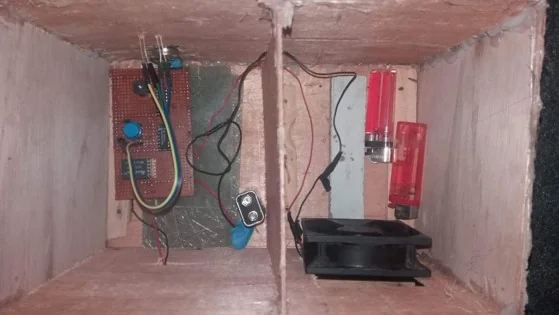
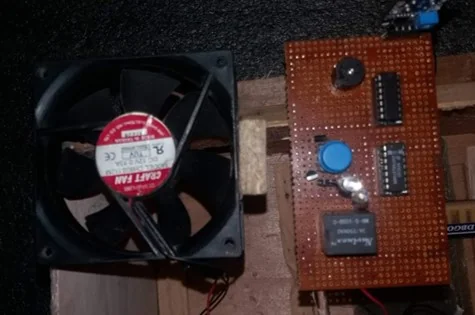
Outcomes & Learnings
The prototype was validated through a controlled test in a sealed 0.5 m³ chamber with a calibrated LPG source. Alarm activation occurred reliably at approximately 200 ppm LPG concentration with a sensor-to-alarm delay under 0.8 s — well within the sub-second target. The 90-second warm-up delay eliminated the false alarm that had occurred in early testing when the sensor was powered cold. Cross-interference testing with ethanol vapor (from hand sanitizer), cooking steam, and acetone produced no false alarms at concentrations representative of normal kitchen use, confirming the MQ-6's selectivity advantage over broadband MQ-2 or MQ-135 sensors for this specific application.
The project established the design pattern for gas safety electronics: sensor selection driven by target-gas selectivity rather than cost alone, hardware warm-up timing to avoid nuisance alarms, dual-output response (alarm plus mitigation action) rather than alarm alone, and fail-visible indicator design. These principles are directly analogous to protection relay design philosophy in power systems — selectivity, speed, sensitivity, and security — which drew a conceptual bridge between undergraduate safety electronics and the protection engineering research pursued in graduate study.
The practical outcome for end users is a system whose total component cost is under $8 USD, manufacturable with off-the-shelf components available in Kathmandu electronics markets, and maintainable without specialized tools — characteristics that make it a realistic safety upgrade for the millions of LPG-using households across South Asia that cannot afford commercially imported gas detectors.